How Much Are Mouse Traps? A B2B Guide to Types, Costs, and Wholesale Buying
August 27, 2026
How much are mouse traps? The price can range from low-cost mechanical products to more complex reusable trapping systems. The final cost depends on trap type, materials, mechanism, packaging, order quantity, customization, and shipping requirements. For example, a basic snap trap usually has a simpler structure than a reusable cage trap, while adhesive products require specific board and glue formulations. Wholesale buyers also receive different quotations based on MOQ, packaging, and production volume.
For pest control companies, hardware distributors, agricultural suppliers, importers, and private-label brands, unit price should not be the only purchasing factor. A cheaper product may create higher replacement costs if its mechanism performs inconsistently. Packaging can also affect freight expenses, warehouse space, and retail presentation. Buyers should therefore evaluate product specifications and total landed cost before selecting a supplier.
This guide explains the main factors that determine mouse trap prices. It also compares common trap types and provides a practical framework for wholesale purchasing. The goal is to help B2B buyers evaluate quotations based on product requirements rather than price alone.
What Determines the Price of a Mouse Trap?
Mouse trap pricing depends on several technical and commercial factors. Two products may perform a similar function but have different production costs because of their materials, construction, mechanisms, and packaging.
For B2B purchasing, it is useful to separate the factory price from the total landed cost. The factory price covers manufacturing and packaging under the agreed quotation. The landed cost can also include freight, insurance, import duties, customs handling, warehousing, and other supply chain expenses.
Trap Type and Mechanism
The trapping mechanism has a direct effect on manufacturing cost. A basic mechanical design may require only a few components, while a reusable cage trap needs additional structural parts and assembly.
Common product categories include:
- Mechanical snap traps
- Live-capture cage traps
- Adhesive glue boards
- Multi-catch traps
- Plastic traps
- Metal traps
Each category serves a different application. Buyers should first identify the intended customer and use environment before comparing prices.
A basic snap trap may suit high-volume retail distribution. A cage trap may serve customers seeking live-capture solutions. Glue boards may fit specific indoor pest management applications where adhesive trapping is permitted and appropriate.
Materials and Construction
Material selection affects both manufacturing cost and product performance.
Metal components can provide mechanical strength for repeated use. Molded plastic can reduce weight and support efficient high-volume production. Some products combine plastic housings with metal springs, trigger parts, or structural components.
Buyers should request the material specification before comparing supplier quotations. Two products with the same external dimensions may use different material thicknesses or component designs.
For example, a stamped metal trap and a plastic-bodied trap may have different production processes. Their prices should not be compared without considering construction and intended service conditions.
Product Size
Product dimensions also influence material consumption, packaging volume, and shipping efficiency.
A larger trap usually requires more raw material and a larger package. However, size should match the target application rather than simply increasing with the expected price.
For a mice trap, the trigger area, capture space, and overall dimensions should correspond to the intended use. An unsuitable size can reduce customer satisfaction and increase returns.
Packaging and Private Label Requirements
Packaging can account for a significant part of the total purchasing cost.
Bulk products for professional pest control companies may use simple inner packs and master cartons. Retail products may require printed boxes, barcodes, multilingual instructions, product labels, and individual packaging.
Private-label projects can also require custom artwork, printing plates, labels, inserts, and packaging samples.
A buyer should request a quotation that clearly separates product cost, packaging cost, and customization charges.
How Much Do Different Types of Mouse Traps Cost?
There is no single wholesale price for all mouse traps. Manufacturers normally calculate quotations according to specifications, order quantity, packaging, and customization.
The following table provides a purchasing framework rather than fixed market prices.
| Trap Type | Typical Positioning | Main Cost Factors | Common B2B Buyers |
|---|---|---|---|
| Basic snap trap | Entry-level mechanical control | Material, spring, trigger, assembly | Hardware distributors and retailers |
| Reusable snap trap | Repeated-use applications | Body design, mechanism, material | Pest control suppliers |
| Cage trap | Live-capture applications | Frame, door, trigger, mesh | Pest control companies and farms |
| Glue board | Adhesive trapping | Board, adhesive, coating, packaging | Pest control distributors |
| Multi-catch trap | Repeated commercial use | Housing, mechanism, serviceability | Pest management companies |
| Customized trap | Private-label projects | Design, tooling, packaging, quantity | Importers and brands |
Caption: Mouse trap pricing varies according to construction, materials, order volume, packaging, and customization requirements.
The table also shows why unit price should not determine the purchasing decision by itself.
A reusable product may cost more initially but provide a different operating cycle. A disposable product may have a lower unit price but require more frequent replacement.
Buyers should calculate the expected cost per application, including replacement frequency and handling requirements.
Example of Two Wholesale Quotations
Consider two suppliers offering different mechanical traps.
Supplier A quotes $0.40 per unit. Supplier B quotes $0.55 per unit.
Supplier A appears cheaper at first. However, suppose its construction results in a higher replacement rate during commercial use.
Supplier B may have a higher purchase price but better suitability for repeated handling.
This does not mean Supplier B is automatically the better choice. The buyer needs product samples and performance information before making that conclusion.
The example demonstrates a basic procurement principle: compare equivalent specifications before comparing unit prices.
Which Type of Mouse Trap Should Wholesale Buyers Choose?
The right product depends on the target market, application, installation environment, and customer expectations.
A distributor does not necessarily need one trap for every customer. A balanced product range can cover different price levels and use cases.
Mouse Snap Traps for High-Volume Distribution
Mouse snap traps use a mechanical trigger and spring-loaded striking mechanism. Their relatively simple construction makes them suitable for many retail and professional distribution channels.
The U.S. Environmental Protection Agency identifies snap traps as one mechanical option for controlling rodent infestations. EPA also recommends combining trapping with measures that prevent rodents from entering or accessing food and shelter.
For B2B buyers, important specifications include:
- Trigger sensitivity
- Spring strength
- Material thickness
- Product dimensions
- Setting method
- Reusability
- Packaging format
- Cleaning requirements
Hardware distributors may prioritize compact packaging and retail presentation. Pest control companies may focus more on mechanism consistency and repeated field use.
Mouse Trap Cage for Live-Capture Applications
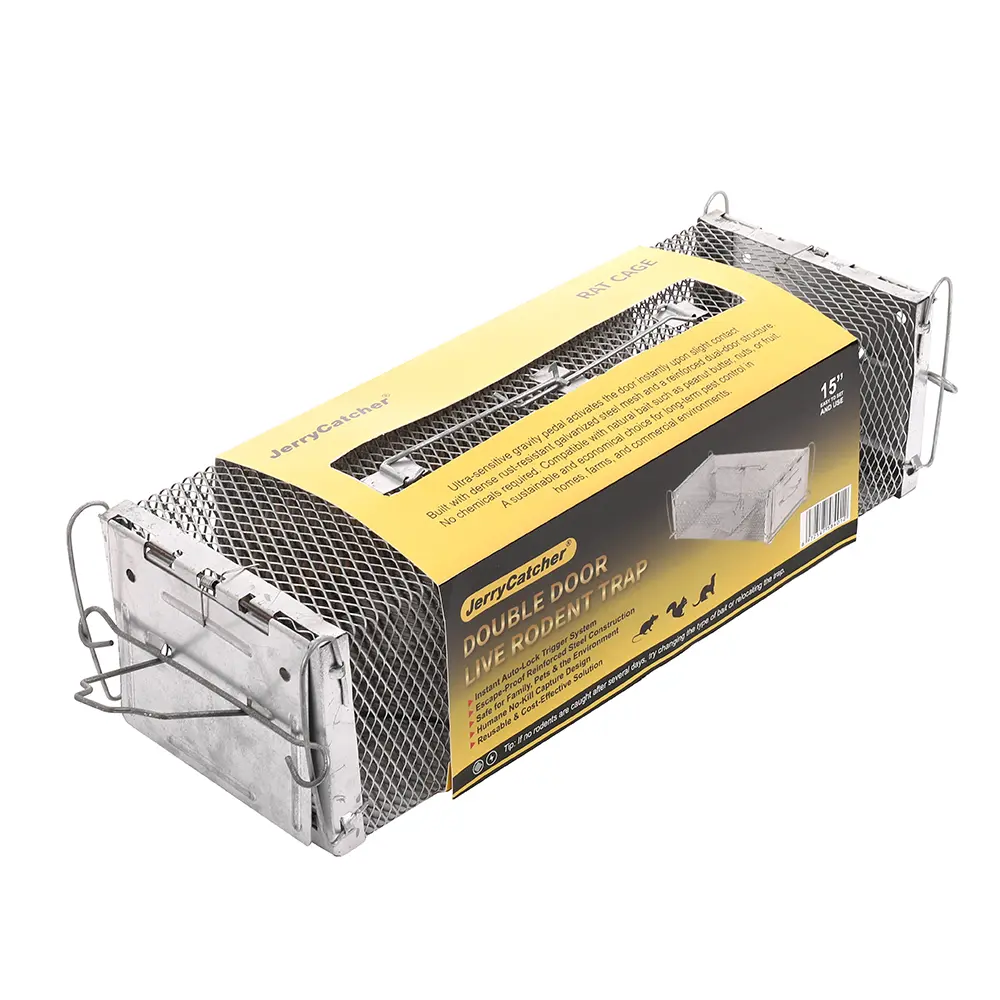
A mouse trap cage captures the animal inside an enclosed structure rather than using a conventional snap mechanism.
Cage traps can serve customers who prefer live-capture methods. Their manufacturing cost depends on the frame, mesh or housing, door structure, trigger mechanism, and assembly process.
EPA recognizes live traps as one type of rodent control device. However, trapping alone does not prevent rodents from returning if access points remain open.
For importers, cage traps also require attention to shipping volume. Their larger dimensions can reduce container utilization compared with compact mechanical products.
Mouse Glue Boards for Adhesive Trapping
Glue boards use a pressure-sensitive adhesive surface to capture rodents that contact the treated area.
A buyer evaluating a mouse glue board should review adhesive coverage, board rigidity, environmental conditions, protective packaging, and storage requirements.
The adhesive formulation and board construction can affect product usability. Temperature, dust, moisture, and storage conditions may also influence adhesive performance.
For professional buyers, packaging is particularly important because the adhesive surface needs protection during transportation and storage.
Multi-Catch and Reusable Systems
Multi-catch traps allow more than one capture before the unit requires servicing, depending on the product design.
These systems usually involve a more complex housing and internal mechanism. Their purchase price can therefore exceed that of basic snap traps.
The commercial value depends on the intended application. A pest management company servicing commercial buildings may evaluate labor savings and servicing frequency. A retail distributor may focus more on customer demand and shelf price.
What Affects Wholesale Mouse Traps Pricing?
Wholesale pricing depends strongly on order conditions.
A supplier may offer different prices for 500 units, 5,000 units, and 50,000 units because production planning, packaging, and material procurement change with order volume.
Minimum Order Quantity
MOQ is one of the first factors buyers should confirm.
A low MOQ can help small distributors test a new product. A higher MOQ may support better production efficiency and pricing for established importers.
However, buyers should avoid choosing an MOQ based only on the lowest unit cost. Excess inventory can create storage costs and slow-moving stock.
A practical purchasing plan should consider:
- Monthly sales volume
- Seasonal demand
- Warehouse capacity
- Lead time
- Product shelf life
- Packaging requirements
- Expected reorder cycle
Packaging Efficiency
Packaging directly affects freight costs.
Compact products generally allow better carton utilization. Larger retail boxes can increase cubic volume even when the actual trap remains small.
For this reason, buyers should request both product dimensions and packed carton dimensions.
A useful quotation should also state the number of units per inner box and master carton.
Customization
Private-label buyers may request customized colors, logos, labels, packaging, or product structures.
Customization can increase the initial cost because it may require tooling, molds, printing plates, samples, and additional production preparation.
Buyers should confirm whether these charges are one-time costs or recurring costs.
Order Planning
Large buyers can sometimes reduce purchasing costs through planned production schedules.
Instead of placing frequent small orders, an importer may negotiate several production batches based on an annual demand forecast.
This approach can help suppliers plan raw materials and production capacity. It can also give the buyer more predictable inventory availability.
What Should Buyers Check Before Purchasing Wholesale Mouse Traps?
A supplier quotation should include enough technical information to make different offers comparable.
Mechanism Performance
For mechanical traps, buyers should check trigger consistency and spring performance.
Samples from different production batches can help identify variation. A professional buyer should also inspect whether the trap remains functional after repeated setting and handling when reuse is part of the intended application.
For cage traps, inspect the door mechanism, trigger response, structural stability, and ease of resetting.
For adhesive products, inspect board quality, adhesive coverage, release paper, and packaging protection.
Material Consistency
Material specifications should remain consistent across production batches.
For example, a change in metal thickness can alter mechanical performance. A change in plastic formulation can affect rigidity.
Buyers should establish key specifications before mass production and use approved samples as a reference.
Quality Inspection
A clear inspection process can reduce problems during large-volume purchasing.
Typical inspection points include:
- Product dimensions
- Material appearance
- Mechanical function
- Adhesive coverage
- Packaging condition
- Printing quality
- Carton quantity
- Product labeling
For large orders, buyers can also agree on an inspection standard and sampling plan before production.
Packaging and Transportation
Mouse traps can contain springs, metal parts, plastic components, or exposed adhesive surfaces. Packaging should protect the product from deformation and contamination.
Glue-based products need particular attention during transport and storage. The protective layer should remain intact, and cartons should prevent excessive pressure on the adhesive surface.
Cage traps also require suitable packaging because their structure can occupy more shipping volume.
Destination-Market Requirements
Pest control products can face different requirements depending on the destination market and product claims.
The U.S. Environmental Protection Agency distinguishes pesticide devices from pesticide products and provides guidance for products that use physical or mechanical means to control pests.
This distinction matters for importers and private-label brands.
Before placing a large order, buyers should confirm the applicable requirements for product claims, labeling, packaging, and import documentation.
How Can Distributors Build a Mouse Trap Product Range?
A distributor can build a product portfolio around customer requirements rather than offering multiple products with minimal differences.
An entry-level mechanical trap can cover price-sensitive retail demand. A reusable product can target professional users. Cage traps can serve live-capture applications. Adhesive products can cover customers looking for non-mechanical trapping options.
This structure creates clear differences between SKUs.
The buyer should define each product according to:
- Target customer
- Application
- Price level
- Product construction
- Packaging format
- Order quantity
- Expected sales volume
For example, a hardware distributor may need compact retail packaging with clear product information. A pest control wholesaler may prefer bulk packaging that reduces handling and packaging costs.
A private-label brand may require a different combination of product specifications and packaging.
The important point is to avoid adding SKUs without a clear commercial purpose. A smaller range with distinct applications can be easier to manage than a large range of nearly identical products.
FAQ About Mouse Trap Prices and Wholesale Buying
How much do mouse traps cost?
Mouse trap prices vary by product type, material, mechanism, packaging, order quantity, and customization. Basic mechanical traps generally have simpler construction than cage or multi-catch systems. Wholesale buyers should request quotations based on exact specifications.
Are mouse snap traps cheaper than cage traps?
They are often less expensive because they can use fewer components and require less material. Cage traps require a housing, door mechanism, trigger system, and additional assembly. Actual pricing depends on design and order volume.
What affects the price of mouse glue boards?
The main factors include board material, adhesive formulation, adhesive coverage, board dimensions, release paper, packaging, and order quantity. Storage and shipping conditions can also affect the total cost.
What is a mouse trap cage used for?
A cage trap captures a mouse inside an enclosed structure. It can serve customers who prefer live-capture methods. Buyers should consider trap dimensions, door design, trigger sensitivity, and handling requirements.
Are glue boards suitable for every environment?
No. Adhesive performance can change under different temperature, humidity, and dust conditions. Buyers should select products according to the intended application and storage environment.
EPA materials also recognize glue boards as physical rodent control devices.
What should I ask a wholesale mouse trap supplier?
Ask about materials, dimensions, mechanism design, MOQ, packaging, carton dimensions, lead time, quality inspection, customization, and destination-market requirements.
Request samples before placing a large order when product performance is important.
Is the cheapest mouse trap the best option for wholesale buyers?
Not necessarily. Unit price should be evaluated with product specifications, replacement frequency, packaging, freight, and expected application.
A slightly higher purchase price can make commercial sense if the product better matches the customer’s requirements.
Can mouse traps be customized for private-label brands?
Many manufacturers can support private-label projects, depending on product design and order quantity. Customization may cover colors, labels, packaging, logos, dimensions, and other agreed specifications.
How should buyers calculate the real cost of a mouse trap?
Start with the factory unit price. Then add packaging, freight, insurance, duties, customs charges, warehousing, and other applicable expenses.
For reusable products, also consider expected service life and replacement frequency.
About Lanxi Puyoung
Lanxi Puyoung supplies mouse traps and pest control products for distributors, wholesalers, importers, pest management companies, and private-label brands. The product range covers mechanical traps, cage traps, glue boards, and other rodent control solutions. Lanxi Puyoung works with B2B customers on product specifications, packaging, order quantities, and supply requirements. The company can also evaluate product configurations according to the target market and intended application.
References
U.S. Environmental Protection Agency. “Options for Dealing with Rodent Infestations.” EPA provides information on snap traps, live traps, and other approaches to rodent control. EPA: Options for Dealing With Rodent Infestations
U.S. Environmental Protection Agency. “Pesticide Devices: A Guide for Consumers.” This resource explains EPA’s approach to certain pest-control devices that use physical or mechanical means. EPA: Pesticide Devices
U.S. Environmental Protection Agency. “Pesticide Labeling Questions & Answers.” This resource provides regulatory information related to pesticide labeling and pest-control products. EPA: Pesticide Labeling Questions & Answers
U.S. Environmental Protection Agency. “Do’s and Don’ts of Pest Control.” This resource provides general guidance on integrated pest management and pest prevention. EPA: Do’s and Don’ts of Pest Control