How to Catch a Mouse With a Trap: What Should B2B Buyers Know?
August 20, 2026
The most reliable way to catch a mouse with a trap is to place the right trap along an active mouse route and check it regularly. For many indoor applications, mouse snap traps provide a direct mechanical control method. A mouse trap cage can suit live-capture requirements, while mouse glue boards offer another trapping format for markets where their use is permitted. The trap itself is only one part of the process. Correct placement, suitable bait, product design, sanitation, and exclusion all affect results. The U.S. EPA recommends identifying and preventing rodent access while using appropriate trapping methods. For B2B buyers, these factors also influence product selection. Distributors need to understand how each trap works before choosing wholesale mouse traps for different customer groups.
Where Should You Place a Mouse Trap?
Trap placement is one of the most important factors in mouse control.
Mice often move along walls, behind appliances, inside cabinets, and through other protected areas. They tend to use established routes rather than cross large open spaces without cover.
This makes location more important than simply placing a trap near the center of a room.
The CDC recommends placing snap traps in areas with evidence of mouse activity. These signs can include droppings, nesting material, urine, and damaged food packaging.
For commercial users, this principle applies across many environments.
A warehouse may have activity near stored goods. A restaurant may find signs near food storage or service areas. A residential customer may notice droppings behind kitchen appliances.
The product should therefore support practical placement.
Identify Signs of Mouse Activity
Before setting a trap, users should inspect the area.
Common signs include:
- Mouse droppings
- Chewed food packaging
- Nesting materials
- Gnaw marks
- Small openings around walls
- Unusual odors
- Tracks or other signs of movement
The EPA recommends sealing openings and removing food, water, and nesting sources as part of rodent prevention.
This creates a simple principle for trap users. First identify the activity. Then select the trap. Finally, address the conditions that allow mice to remain in the area.
Place Traps Along Active Routes
For many indoor situations, a trap works best when it intersects the mouse’s normal travel path.
For snap traps, the CDC recommends placing the baited end close to the wall. The trap should form a “T” with the wall.
This positioning takes advantage of normal mouse movement.
A distributor can include placement instructions with the product. Clear instructions help end users understand why placement matters.
This also reduces the chance of customers blaming the trap for poor results caused by unsuitable positioning.
How Do You Set Mouse Snap Traps?
Mouse snap traps use a mechanical spring and trigger mechanism.
The user prepares the trap according to the manufacturer’s instructions. The trap then activates when a mouse interacts with the trigger.
The CDC identifies snap traps as an effective method for temporary mouse control.
For B2B buyers, the design should support consistent operation.
Important features include trigger sensitivity, spring action, base stability, and ease of setup.
A trap that looks simple still requires careful engineering.
Select the Right Trap Size
Mouse traps and rat traps are not interchangeable in every application.
The target species affects trap dimensions and trigger design.
The CDC recommends choosing the correct snap trap for the rodent being controlled.
For distributors, this distinction matters when building a product range.
A product description should clearly state the intended target.
It should also provide relevant dimensions and operating instructions.
Choose an Appropriate Bait
Bait can help attract mice to a snap trap.
The CDC has recommended small amounts of suitable food bait, including peanut butter, for snap traps.
The exact bait depends on the application and local practice.
Users should follow the trap manufacturer’s instructions.
Too much bait can make the trap harder to trigger correctly.
A small amount can keep the mouse focused on the trigger area.
For commercial products, the baiting instructions should remain simple.
Complex instructions can reduce correct use in the field.
Position the Trigger Correctly
The trigger should face the expected path of the mouse.
For wall placement, the trap can sit perpendicular to the wall with the baited end next to the wall.
This arrangement creates a direct route across the trigger.
For B2B buyers, trap geometry matters here.
A stable base helps prevent movement after placement.
A well-designed trigger should also remain functional after repeated handling.
When Should You Use a Mouse Trap Cage?
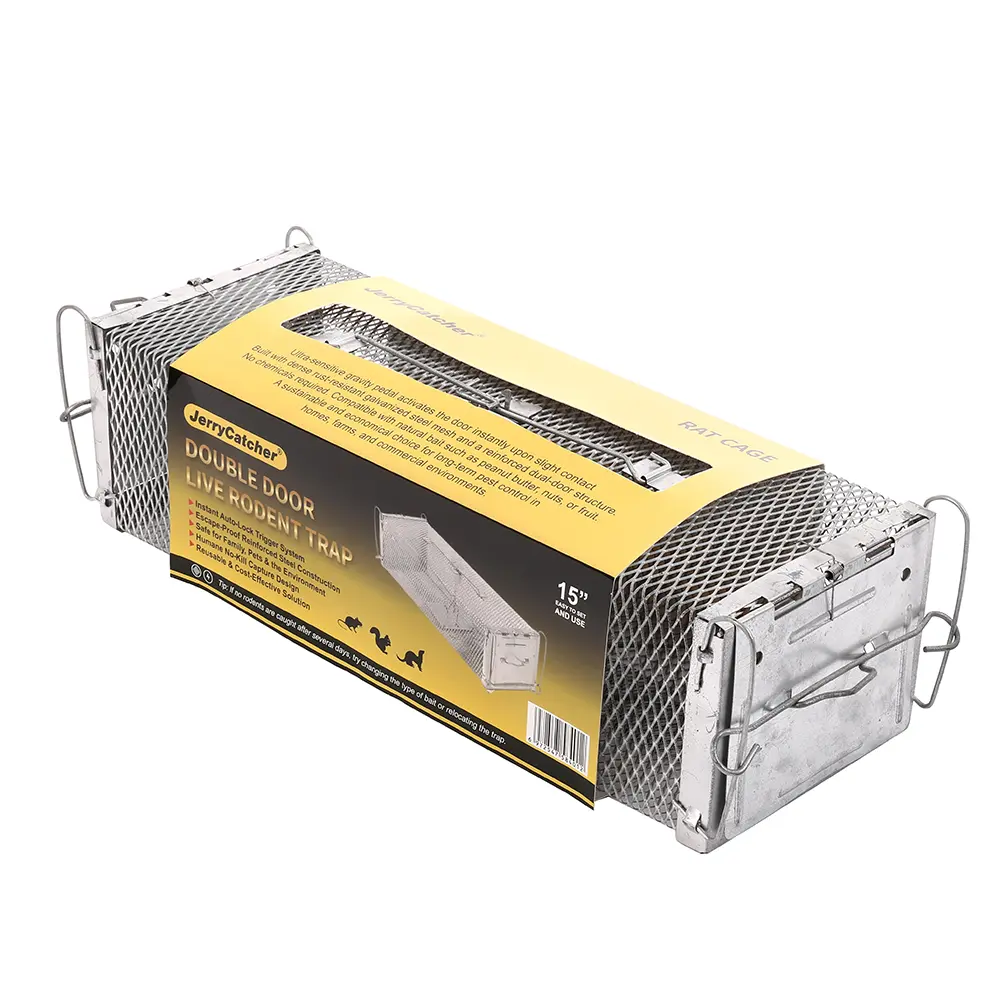
A mouse trap cage can suit customers who prefer live capture.
The cage normally contains an entry mechanism and a closing door.
When the mouse activates the mechanism, the door closes.
The animal remains inside the cage until the user checks the trap.
The EPA recognizes cage-type live traps as an option for capturing rodents alive. It also notes that captured rodents still require appropriate handling.
This makes cage traps different from snap traps.
They require a clear plan for inspection and handling.
Where Can Cage Traps Fit Commercial Applications?
Cage traps may suit:
- Facilities with live-capture preferences
- Monitoring programs
- Certain non-lethal control applications
- Educational or research settings
- Customers with specific animal-welfare requirements
However, regulations and customer expectations differ by market.
The supplier should not assume that every destination market treats live capture in the same way.
A distributor should check applicable local requirements before selling a cage trap.
Cage Size Matters
The trap should match the target species.
A cage designed for rats may have dimensions that do not suit mouse behavior.
This is why product specifications should include:
- Overall dimensions
- Entry dimensions
- Target species
- Trigger type
- Cage material
- Door mechanism
- Recommended placement
For example, a live rat trap cage can address a different application from a compact mouse cage.
Clear product positioning helps distributors avoid incorrect purchases.
Are Mouse Glue Boards Suitable for Catching Mice?
Mouse glue boards use an adhesive surface to restrict movement when a mouse contacts the board.
They provide a compact trapping format and require no spring mechanism.
However, buyers should consider market regulations and animal-welfare requirements before selecting them.
The CDC has advised against glue traps in certain household rodent-control guidance.
Therefore, glue boards should not receive a universal recommendation.
Their suitability depends on the intended market and application.
EPA guidance also treats glue boards without attractants as pest-control devices under applicable U.S. rules.
What Should Buyers Check?
For adhesive products, buyers should evaluate:
| Evaluation Area | Why It Matters |
|---|---|
| Adhesive strength | Affects trapping performance |
| Board size | Determines usable trapping area |
| Adhesive coverage | Supports consistent contact |
| Storage conditions | Can affect adhesive performance |
| Shelf life | Important for inventory planning |
| Packaging | Protects the adhesive surface |
| Folding design | Influences placement options |
| Instructions | Supports correct customer use |
Caption: Key evaluation points for mouse glue board products.
Environmental conditions can affect adhesive performance.
High temperatures, dust, moisture, and prolonged storage may influence the adhesive.
Wholesale buyers should request storage recommendations from the supplier.
Tunnel-Style Glue Traps
A tunnel mouse trap can provide a more enclosed placement format.
The tunnel structure can help guide the mouse toward the adhesive area.
This design can also provide a more defined placement zone.
For distributors, tunnel-style products may serve customers who prefer a contained format rather than an exposed glue board.
A mouse tunnel trap can also be positioned as a product for specific indoor environments.
The actual application should always follow the product instructions and local requirements.
How Should B2B Buyers Compare Mouse Trap Types?
A buyer should compare trap types according to application rather than asking which product is universally best.
Each design has different operating characteristics.
| Trap Type | Main Function | Key Strength | Main Consideration |
|---|---|---|---|
| Snap trap | Mechanical capture | Direct mechanical action | Requires careful placement |
| Cage trap | Live capture | Allows live capture | Requires regular inspection |
| Glue board | Adhesive capture | Compact design | Regulatory and welfare considerations |
| Tunnel glue trap | Guided adhesive capture | Defined placement area | Storage and adhesive conditions |
| Multiple-catch design | Repeated capture | Can handle multiple interactions | Requires suitable monitoring |
Caption: Practical comparison of mouse trap formats for commercial purchasing.
For a distributor, a mixed product range may make more sense than one universal product.
A retail customer may prefer a simple snap trap.
A pest control company may need several formats.
A customer with live-capture requirements may choose a cage.
The purchasing decision should therefore begin with the application.
Product Selection by Customer Type
Different customers have different priorities.
| Customer | Possible Priority |
|---|---|
| Retailer | Easy setup and clear packaging |
| Pest control company | Durability and field handling |
| Warehouse | Practical placement and inspection |
| Food facility | Monitoring and hygiene procedures |
| Property manager | Simple maintenance |
| Distributor | Price, packaging, consistency, and supply |
Caption: Example purchasing priorities across B2B mouse trap customers.
This approach gives sales teams a clearer way to recommend products.
It also helps manufacturers develop more targeted product ranges.
How Can Wholesale Mouse Traps Improve Commercial Product Selection?
Wholesale purchasing introduces additional factors.
The buyer needs consistent products across large quantities.
A sample may look acceptable, but production consistency determines the actual commercial result.
For this reason, buyers should evaluate both the product and supplier.
Sample Testing
Before placing a large order, request samples.
Inspect the actual product rather than relying only on photographs.
For snap traps, check:
- Trigger operation
- Spring performance
- Base stability
- Material quality
- Reset function
- Dimensions
For cage traps, inspect:
- Door movement
- Trigger response
- Wire or panel construction
- Entry dimensions
- Locking function
For glue products, check:
- Adhesive coverage
- Board dimensions
- Packaging
- Folding structure
- Storage requirements
Sample testing gives buyers a practical quality reference.
Production Consistency
After sample approval, buyers should establish clear specifications.
These can include:
- Material requirements
- Dimensions
- Tolerance
- Packaging
- Labeling
- Color
- Carton quantity
- Inspection standards
This becomes especially important for private-label orders.
A consistent reference sample can help both buyer and supplier understand the expected production standard.
Packaging and Shipping
Trap products often travel through several logistics stages.
Packaging needs to protect the mechanism or adhesive surface.
Carton dimensions also influence shipping costs.
A B2B buyer should request:
- Unit packaging dimensions
- Carton dimensions
- Units per carton
- Net weight
- Gross weight
- Loading quantity
- Pallet information
These details help purchasing teams calculate landed costs.
What Common Mistakes Reduce Trap Performance?
Many unsuccessful trapping attempts result from incorrect placement or unsuitable conditions.
The trap may work correctly, but the user places it where mice rarely travel.
Another problem occurs when users ignore food sources.
If mice have easy access to food elsewhere, the trap may receive less interaction.
The EPA recommends removing food and water sources while preventing rodent access.
Placing Too Few Traps
One trap may not match a larger infestation. The CDC has recommended using multiple snap traps across infested areas.
Commercial users should assess the scale of the problem before deciding on trap quantity.
For distributors, this creates an opportunity to provide clear placement guidance.
The customer should understand that one product does not necessarily equal one infestation solution.
Ignoring Entry Points
Trapping does not address how mice enter a building. Small openings can allow new rodents to enter after existing mice are removed. The EPA recommends sealing holes and gaps to reduce rodent access. For this reason, trapping should form part of a wider control plan.
A successful strategy can combine:
- Inspection
- Exclusion
- Sanitation
- Trap placement
- Monitoring
- Follow-up inspection
This approach can provide better long-term control than relying on trapping alone.
How Should Businesses Handle a Captured Mouse?
Handling procedures depend on the trap type.
Snap traps and glue boards require safe removal and disposal according to applicable guidance.
Cage traps require live-animal handling.
Users should avoid direct contact with rodents and contaminated materials.
The CDC provides guidance on cleaning rodent waste and handling contaminated areas.
Businesses should also keep traps away from children and pets.
The EPA specifically recommends placing traps where children and pets cannot reach them.
Inspection Frequency
Traps should be checked according to the product instructions and the requirements of the control program.
Regular inspection helps users identify whether the selected trap and placement are working.
It also prevents captured animals from remaining unnoticed.
For commercial facilities, inspection records can help identify recurring activity.
This information can guide future placement decisions.
What Should Distributors Look for in a Mouse Trap Supplier?
A reliable supplier should provide more than a product catalog.
B2B buyers need clear technical information and predictable production.
Supplier evaluation can cover several areas.
Product Capability
Ask whether the supplier can provide:
- Multiple trap formats
- Different sizes
- Custom packaging
- Private labeling
- Product samples
- Technical specifications
- Inspection support
- Export packaging
A broad product capability can simplify purchasing for distributors.
However, buyers should still select products based on actual demand.
Quality Control
The supplier should have a defined inspection process.
Mechanical products need functional checks.
Adhesive products need appropriate adhesive and packaging checks.
The inspection standard should match the product category.
For example, a spring mechanism requires a different test from a glue board.
This distinction helps create more meaningful quality criteria.
Regulatory Awareness
Requirements differ across countries.
EPA guidance explains that certain mechanical pest-control products fall under the category of devices, while labeling and other requirements may still apply.
Buyers should confirm destination-market requirements before placing orders.
This is especially important for products involving adhesive materials or specific pest-control claims.
How Can a Distributor Build a Mouse Trap Product Range?
A practical product range should cover several use cases.
One possible structure includes:
Basic Mechanical Traps
Mouse snap traps can form the core of a general-purpose range.
They are familiar to many customers and have a simple operating principle.
Adhesive Traps
A mouse trap glue pad can provide another format for customers seeking adhesive products.
The distributor should clearly explain the intended use and applicable restrictions.
Live-Capture Traps
A humane rat trap cage can serve customers who require cage-based capture.
The distributor should specify whether the product targets rats, mice, or both.
This prevents incorrect product selection.
Segmented Product Information
Product pages should answer practical purchasing questions.
For example:
- What species does the trap target?
- What are the product dimensions?
- How does the mechanism work?
- Is it reusable?
- What materials does it use?
- How should it be positioned?
- How should users handle a captured animal?
- What packaging options are available?
This type of information supports both distributors and end users.
FAQ About Catching Mice With Traps
What is the best way to catch a mouse with a trap?
Choose a trap suited to the application and place it along an active mouse route. Snap traps are widely used for indoor mechanical control.
Where should I place mouse snap traps?
Place them where you see signs of mouse activity. The CDC recommends positioning the baited end next to a wall for many snap-trap applications.
What bait should I use in a snap trap?
A small amount of suitable food bait can attract mice. The CDC has recommended peanut butter among suitable options. Users should follow the manufacturer’s instructions.
Can a mouse trap cage catch mice alive?
Yes. Cage traps are designed to capture rodents without killing them. However, captured animals still require appropriate handling.
Are mouse glue boards suitable everywhere?
No. Their acceptance and recommended use vary by market. Buyers should check local regulations and animal-welfare requirements before distribution.
How many traps should a business use?
The quantity depends on the size and severity of the infestation. The CDC recommends using multiple traps across affected areas rather than relying on one trap.
Can traps solve a mouse infestation by themselves?
Not always. Rodent exclusion, sanitation, food management, and monitoring should also form part of the control strategy.
What should I check when buying wholesale mouse traps?
Review product dimensions, materials, mechanism, packaging, sample quality, production consistency, minimum order quantity, lead time, and destination-market requirements.
Should a distributor stock several trap types?
A mixed range can serve different customer needs. Snap traps, cage traps, tunnel traps, and glue boards each have different applications.
What should a supplier provide before a large order?
A supplier should provide representative samples, specifications, packaging details, production information, inspection standards, and relevant documentation.
Why Choose Lanxi Puyoung for Mouse Trap Supply?
Lanxi Puyoung supplies mouse and rodent control products for distributors, pest control companies, retailers, and commercial buyers. Its product range covers different trapping formats for varied purchasing requirements. For B2B customers, Lanxi Puyoung focuses on product specifications, sample evaluation, packaging, production consistency, and commercial supply needs. Buyers can select products according to target species, application, market requirements, and customer preferences. This approach helps distributors build a more practical range of wholesale mouse traps while giving customers clearer information about how each trap should be used.
References
The U.S. Environmental Protection Agency provides guidance on rodent control methods, including snap traps and cage-type live traps. It also recommends prevention measures and safe trap placement.
The Centers for Disease Control and Prevention provides technical information on rodent trapping methods, including snap traps, glue boards, and live traps.
The Centers for Disease Control and Prevention provides guidance on snap-trap placement, rodent prevention, and safe cleanup after rodent activity.
The U.S. Environmental Protection Agency provides information about the regulatory treatment of mechanical pest-control devices, including mouse snap traps and glue boards.