Do Mouse Glue Traps Work for Commercial Rodent Control?
September 16, 2026
Yes, mouse glue traps can capture mice when the trap has adequate adhesive strength and sits directly in an active travel route. However, capture performance depends on more than the glue itself. Rodent size, placement, temperature, dust, surface contamination, and trap design all influence results. For B2B buyers, the more useful question is whether a glue trap matches the target rodent and operating environment.
Glue boards work through physical capture. A rodent steps onto the adhesive surface and becomes restrained. Unlike bait-based products, the trap does not depend on the animal consuming a toxic substance. This makes adhesive capture a distinct category within rodent control products.
Research and pest-management guidance also show important limitations. UC Integrated Pest Management notes that glue boards can catch house mice, but adult mice may sometimes detect and avoid the adhesive. Dust and extreme temperatures can also reduce effectiveness.
For commercial buyers, this means product selection should start with application conditions. A warehouse, food-processing facility, hotel, retail store, and residential distributor may need different trap configurations. Mouse size also matters. Products intended for rats require different considerations because rats are larger, stronger, and more cautious around unfamiliar objects.
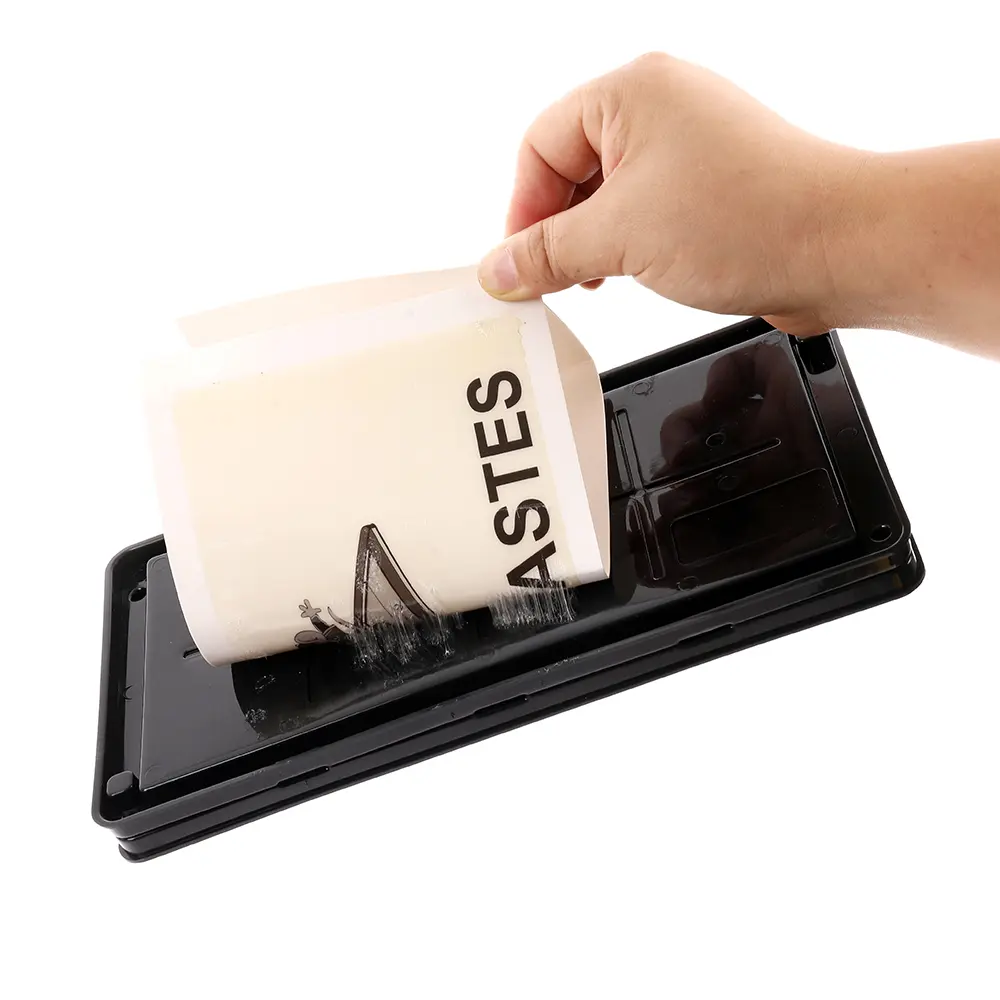
How Do Mouse Glue Traps Work?
Mouse glue traps use a pressure-sensitive adhesive that holds a rodent when it crosses the trapping surface. The basic mechanism looks simple, but several design factors determine whether the trap performs consistently.
A glue board normally consists of a base material and an adhesive layer. Some designs fold into enclosed structures. Others remain as flat boards with a broad exposed trapping area.
The goal is to position the adhesive across the rodent’s normal route. Rodents often travel along walls, edges, hidden passages, and areas between food sources and shelter. UC IPM recommends placing traps where there is evidence of mouse activity, such as droppings or gnaw marks.
Adhesive Coverage
Adhesive coverage directly affects the available capture area.
A narrow adhesive strip may work when a mouse follows a precise route. A wider board provides more opportunity for the animal to contact the adhesive.
For B2B products, the useful measurement is not simply the overall board size. Buyers should examine the effective adhesive area, adhesive distribution, substrate, and folding configuration.
Adhesive Tack and Holding Strength
Rat glue and mouse glue need to maintain their physical properties during storage and use.
The adhesive should remain sufficiently tacky under the stated operating conditions. However, excessive reliance on a high-tack claim does not guarantee field performance.
Dust, fibers, oil, moisture, and other contaminants can cover the adhesive surface. Once contamination accumulates, the effective contact area decreases.
For this reason, product performance should consider both adhesive formulation and the environment where the trap will operate.
Capture Depends on Contact
A glue board cannot capture a rodent that does not step onto the adhesive.
This sounds obvious, but it explains many apparent product failures. A trap placed several inches away from the active runway may remain unused even when rodents are nearby.
Placement therefore works together with adhesive performance. A well-designed trap in the wrong location can still produce poor results.
When Do Mouse Glue Traps Work Best?
Mouse glue traps generally work best when the target animal has an established travel route and the adhesive surface remains clean and functional.
Commercial environments often provide clear indicators of these routes. Droppings, gnaw marks, nesting materials, grease marks, and repeated sightings can help identify active areas.
A practical rodent-control program should use these signs to guide trap placement rather than distributing traps randomly.
Along Walls and Edges
House mice frequently move along walls and other protected edges. UC IPM recommends placing traps along walls and near locations showing evidence of mouse activity.
This behavior makes wall-adjacent placement important for commercial installations.
For example, a warehouse may have rodent activity along the base of storage racks. A glue board placed in the open center of the aisle may receive little traffic.
A trap placed beside the rack edge may intercept the animal’s normal route.
Near Evidence of Rodent Activity
Look for signs before deciding where to install a trap.
Useful indicators include:
- Droppings
- Gnaw marks
- Nesting materials
- Tracks
- Grease marks
- Damaged packaging
- Repeated sightings
The CDC also recommends checking where rodents enter and sealing gaps after identifying activity. Mice can enter openings around 1/4 inch, or 6 millimeters, in diameter.
This illustrates an important B2B principle. Trapping removes existing animals, while exclusion reduces future entry.
In Protected Locations
Glue boards can lose effectiveness when dust or debris covers the adhesive.
UC IPM specifically notes reduced effectiveness in dusty areas. It also recommends keeping glue boards away from children, pets, and desirable wildlife.
For industrial facilities, enclosed stations or protected trap placements can therefore help maintain the adhesive surface.
Protection also reduces the chance of accidental contact with the adhesive.
Are Rodent Glue Traps Suitable for Rats?
They can be used for rats in some indoor situations, but rat capture presents different challenges from mouse capture.
Rats are larger and stronger than mice. They can also show strong avoidance of unfamiliar objects. UC IPM states that glue boards are available for rat management but are difficult to use and generally not recommended for nonprofessional use.
This difference matters when buyers compare rodent traps based only on product dimensions.
A board designed around mouse behavior should not automatically become a rat product by increasing its size.
Mouse Versus Rat Requirements
The target species affects the required adhesive area, board construction, and installation method.
For rat applications, trap positioning can become more important than simply selecting a larger board.
A rat that detects a new object may avoid the area. This behavior can reduce capture rates even when the adhesive itself has sufficient holding strength.
What About Rat Glue Traps?
Products marketed as rat glue traps should have a clear target specification.
The board needs enough structural stability to remain in position when a larger animal contacts it. The adhesive must also retain its intended properties under the stated environmental conditions.
For B2B buyers, product testing should therefore include the complete trap rather than adhesive strength alone.
What Factors Affect Glue Trap Performance?
A glue board operates within a physical environment. Temperature, dust, humidity, storage conditions, and placement can all influence performance.
A buyer who evaluates only the adhesive formula may miss these operational variables.
Temperature
Temperature can affect adhesive behavior.
Extreme heat may change the consistency of some adhesive formulations. Low temperatures can also reduce tackiness.
UC IPM notes that extreme temperatures may affect the tackiness of glue boards.
This matters for suppliers selling into different climates.
A product stored in a temperature-controlled warehouse may perform differently from one transported or stored in an uncontrolled facility.
Dust and Debris
Dust is one of the most practical limitations for adhesive traps.
When dust accumulates on the glue surface, it creates a physical barrier between the rodent and adhesive. Fine particles can therefore reduce effective contact.
Industrial facilities should assess dust levels before selecting a flat exposed glue board.
A protected design can help in some environments, especially where airborne dust is unavoidable.
Moisture and Contamination
Moisture can interact with the substrate, adhesive, packaging, or surrounding surface.
Food-processing environments may also introduce grease, flour, powder, or food particles. These materials can contaminate the adhesive.
The trap specification should therefore match the actual facility rather than relying on a generic “strong adhesive” claim.
Storage Conditions
B2B buyers often purchase glue boards in bulk. Storage conditions can affect inventory before the traps reach the end user.
Packaging should protect the adhesive from dust and unintended contact. Temperature and humidity recommendations should also be clear.
For distributors, shelf-life information can help with stock rotation and inventory planning.
How Should B2B Buyers Evaluate Rodent Glue Traps?
A commercial purchasing decision should combine product construction, adhesive performance, packaging, target species, and regulatory requirements.
Price alone does not provide enough information to compare different glue boards.
1. Define the Target Rodent
First determine whether the product targets house mice, larger rats, or both.
Mouse and rat products may require different dimensions and adhesive configurations. A mixed pest-control portfolio may therefore need separate SKUs.
2. Define the Installation Environment
Ask where the trap will be used.
Important conditions include:
- Residential interiors
- Warehouses
- Retail stores
- Restaurants
- Food facilities
- Agricultural buildings
- Storage rooms
- Commercial service areas
The same glue board may not suit every environment.
3. Review Adhesive Area
Look at the usable adhesive surface rather than only the overall board dimensions.
A larger board can provide more contact area, but the design must still fit the intended installation location.
Folding structures can also change the available trapping area and protect the adhesive before deployment.
4. Review Substrate Construction
The base needs sufficient rigidity for the intended application.
A board that bends excessively may become difficult to place. A structure that folds into a tunnel can provide a more contained installation format.
For example, a tunnel mouse trap can provide an enclosed configuration for applications where a protected trap format makes more sense.
5. Evaluate Packaging
Packaging protects the adhesive before use.
For wholesale distribution, packaging also affects transportation, warehouse storage, shelf presentation, and product handling.
Buyers should review carton dimensions, pieces per case, individual wrapping, labeling, and storage recommendations.
6. Consider the Target Market
Different markets can impose different labeling and product requirements.
In the United States, EPA considers rodent glue boards to be devices under FIFRA because they use physical means to trap pests. EPA also notes that such devices remain subject to applicable labeling and establishment requirements.
Therefore, suppliers and importers should confirm the requirements that apply to their destination market.
How Do Glue Traps Fit Into a Broader Rodent Control Program?
Glue traps should not be treated as a complete answer to rodent infestation.
Integrated pest management combines monitoring, prevention, exclusion, sanitation, and population reduction. CDC describes IPM as a science-based approach that addresses both pest populations and the conditions that allow infestations to develop.
This approach changes how B2B buyers should evaluate rodent control products.
A trap removes or captures an animal already inside the facility. It does not automatically stop additional rodents from entering.
Exclusion
Inspect doors, walls, pipes, vents, utility penetrations, and other openings.
The CDC recommends sealing gaps and holes and keeping food and garbage properly contained.
This can reduce new rodent entry.
Sanitation
Food availability can influence rodent activity.
Commercial facilities should manage food residues, waste, storage areas, and other potential food sources according to their sanitation procedures.
Removing attractants can make trapping and other control measures more effective.
Monitoring
Monitoring helps determine whether activity continues after traps are installed.
Droppings, gnaw marks, tracks, and new damage can indicate ongoing activity. Trap inspection can then become part of the facility’s routine pest-management process.
CDC recommends continuing trapping until there are no rodents and no new signs for a period of time.
How Should Buyers Compare Different Rodent Traps?
Rodent traps serve different purposes. A B2B buyer should select based on the target pest, application, handling requirements, and local regulations.
Glue boards are only one category within the wider trap market.
Traditional snap traps use mechanical action. Live traps capture rodents without the same type of adhesive restraint. Electronic traps use electrical mechanisms. Glue boards rely on physical adhesion.
The right product therefore depends on the pest-control program and application conditions.
For example, UC IPM identifies snap traps as an effective option for house mice and emphasizes strategic placement. It also identifies glue boards as an alternative while noting their limitations.
For rat control, UC IPM similarly emphasizes the importance of identifying travel routes and notes that glue boards can be difficult to use.
B2B suppliers should therefore avoid positioning every trap as interchangeable.
What Should a Mouse Glue Trap Supplier Test?
Manufacturers can improve product consistency by testing the complete product rather than relying on a single adhesive measurement.
A practical quality-control program may examine:
Adhesive Performance
Test tack and holding performance against the intended target and under defined environmental conditions.
Board Structure
Check board dimensions, folding accuracy, surface condition, and structural stability.
Packaging
Inspect individual packaging, adhesive protection, carton strength, labeling, and storage instructions.
Environmental Conditions
Evaluate product behavior under the temperature and storage conditions relevant to the target market.
Production Consistency
Compare adhesive application across production batches. Uneven adhesive distribution can reduce the usable capture area.
For distributors, documented quality controls can also support supplier qualification and incoming inspection.
FAQ About Mouse Glue Traps
Do mouse glue traps work?
Yes, mouse glue traps can capture mice when the adhesive remains functional and the trap sits on an active travel route.
Their performance depends on placement, mouse behavior, environmental conditions, and trap construction. UC IPM notes that adult mice may detect and avoid glue boards in some situations.
How do rodent glue traps catch mice?
Rodent glue traps use a sticky adhesive surface. When a mouse crosses the surface, its feet and body contact the adhesive.
The trap then physically restrains the animal.
Are glue boards suitable for rats?
Some glue boards are designed for rat applications, but rats create additional challenges because they are larger and often cautious around unfamiliar objects.
UC IPM states that rat glue boards can be difficult to use and require careful knowledge of rat behavior and travel routes.
What is the difference between mouse glue and rat glue?
The main difference involves the target animal and required holding performance.
Rat products generally need to account for greater body weight and strength. Product dimensions, adhesive coverage, and board stability may therefore differ.
Does rat trap glue work in dusty areas?
Dust can reduce adhesive effectiveness by covering the trapping surface.
UC IPM specifically notes that glue boards lose effectiveness in dusty environments unless protected.
Where should glue boards be placed?
Place them near evidence of rodent activity and along likely travel routes.
Walls, edges, dark corners, and areas near droppings can provide useful starting points. The exact placement should reflect the behavior of the target species.
Can glue traps be used outdoors?
Outdoor use requires particular caution.
UC IPM advises against using glue boards outdoors because birds, lizards, and other nontarget wildlife can become trapped.
Local regulations and the specific product label should also be checked before outdoor use.
What are the main limitations of glue traps?
The main limitations include sensitivity to dust, temperature effects, incorrect placement, avoidance by some adult rodents, and risks to nontarget animals.
They should therefore form part of a broader pest-management strategy rather than serve as the only control measure.
Are glue traps considered rodent control products?
Yes. Glue boards are commercially available as physical rodent-control devices.
In the United States, EPA classifies rodent glue board products as devices under FIFRA and applies requirements related to labeling and production establishments.
What should distributors ask a glue trap manufacturer?
Distributors should ask about target species, adhesive type, effective adhesive area, board material, dimensions, packaging, storage conditions, intended environment, quality-control procedures, and destination-market requirements.
These details provide a stronger basis for supplier comparison than adhesive strength claims alone.
Lanxi Puyoung manufactures and supplies adhesive pest-control products for distributors, pest-control companies, and other commercial buyers. The company focuses on product construction, adhesive performance, application requirements, and wholesale specifications for rodent-control programs. For buyers sourcing mouse glue boards, rat-oriented products, or related rodent control products, Lanxi Puyoung can support product selection and specification discussions based on the target market and application.
References
- U.S. Centers for Disease Control and Prevention, “How to Trap Up to Remove Rodents.” The guidance covers trap selection, placement, exclusion, and continued monitoring. CDC Rodent Trapping Guidance
- U.S. Centers for Disease Control and Prevention, “How to Seal Up to Prevent Rodents.” The guidance explains rodent entry points, sanitation, and exclusion. CDC Rodent Exclusion Guidance
- UC Statewide Integrated Pest Management Program, “House Mouse.” The resource discusses mouse behavior, trap placement, glue boards, dust, temperature, and capture limitations. UC IPM House Mouse
- UC Statewide Integrated Pest Management Program, “Rats.” The resource covers rat behavior, trap placement, glue-board limitations, and outdoor-use concerns. UC IPM Rats
- U.S. Environmental Protection Agency, “Pesticide Labeling Questions & Answers.” EPA explains the regulatory treatment of rodent glue boards as devices under FIFRA. EPA Pesticide Labeling Guidance
- U.S. Centers for Disease Control and Prevention, “What Is Integrated Pest Management?” The resource explains IPM as a science-based approach combining prevention, reduction, and environmental management. CDC Integrated Pest Management